
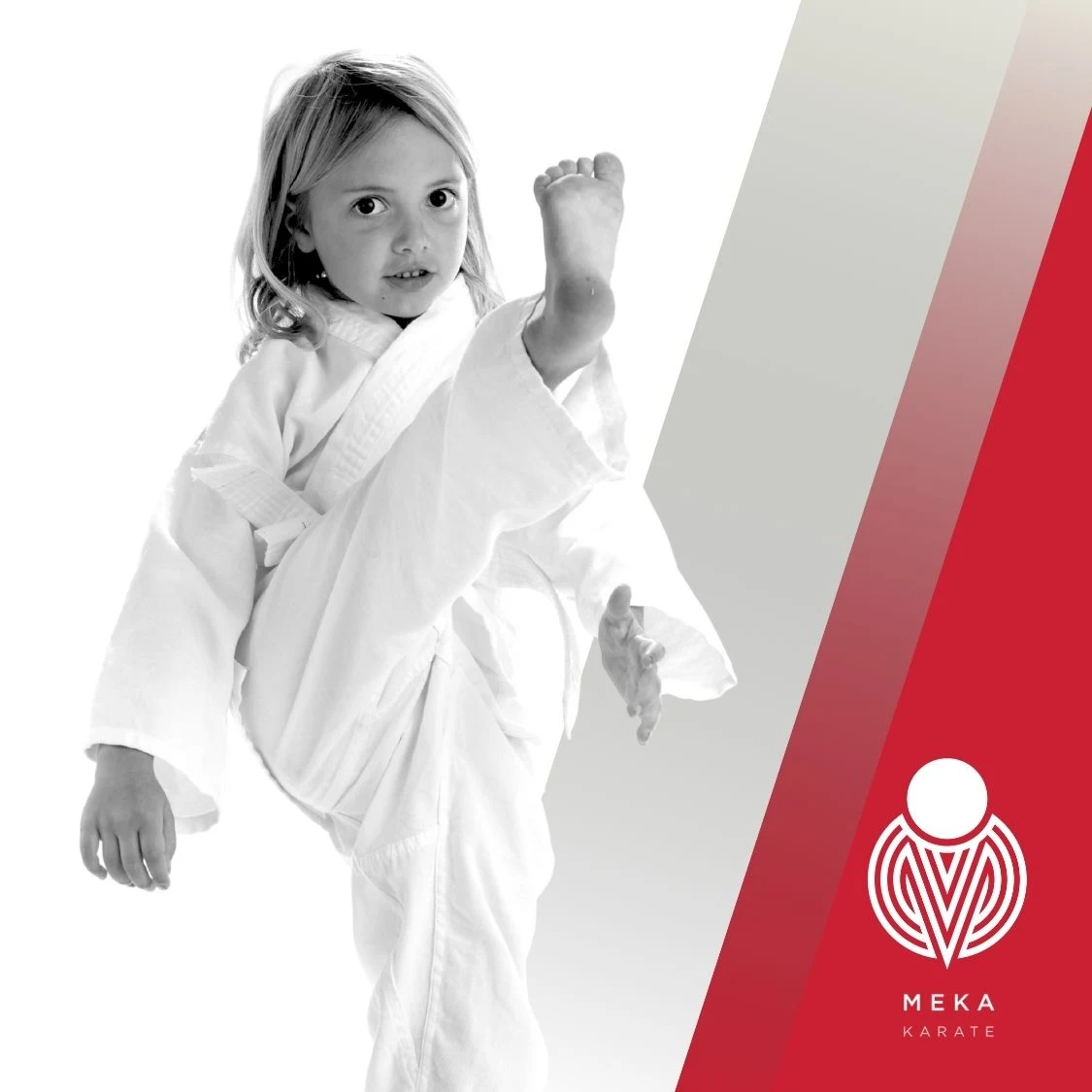
From a distance, a karate kick might look simple. Yet when children begin learning to execute the movement, they often realise it’s much more challenging than it appears. The good news is that a few simple fundamentals can immediately improve your child’s kick.
In this blog, we’ll explore six key tips to help your child increase their kicking height, speed, balance and accuracy. First, it’s important to understand what each tip means and how to apply it during training. Let’s take a closer look:
- Pivot on the Front Foot
- Raise the Knee in a Straight Line
- Pivot on the Ball of the Foot
- Lean Back for Balance and Height
- Keep Eyes on the Target
- Understand Correct Distance
These techniques form the foundation of powerful and precise karate kicks. Read on for a detailed breakdown that your child can start using in their next class.
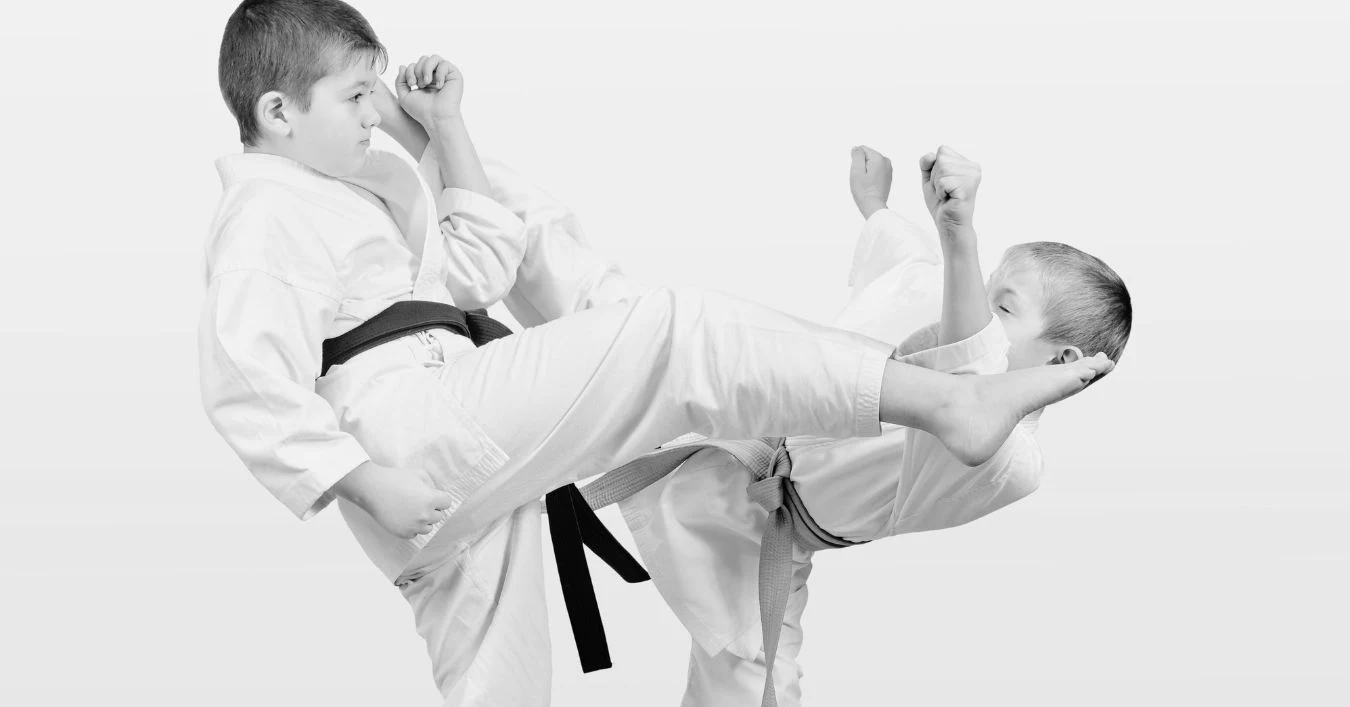
Pivot on the Front Foot
Many children feel like they lack flexibility when attempting a roundhouse kick. Often, however, it’s a technical mistake that holds them back. One of the most common issues is failing to pivot the front foot properly.
To allow full rotation of the hips and improve kicking height, your child must pivot their front foot outward during the kick. If the foot stays flat and faces forward, the hips can’t engage fully. This limits both height and power.
Timing is also essential. The pivot should occur once the kicking leg is airborne, not before. As a guide, the toes of the front foot should ideally point behind the kicker at the peak of the movement. This position gives maximum hip flexibility and allows a higher, more effective kick.
Raise the Knee in a Straight Line
In karate, speed and precision are essential. Techniques should follow a straight path to be most effective, this applies to kicks as well as punches.
If your child swings their leg around in a wide arc, opponents can easily spot the movement and react. By lifting the knee in a straight line toward the target, they reduce telegraphing and increase the element of surprise.
From this position, your child can execute a range of kicks: roundhouse to the body, roundhouse to the head, or even a front kick. This versatility makes it harder for opponents to anticipate the attack.
What about power? That comes from correct hip thrusting at the right moment. Even with a straight-line knee lift, your child can develop strong kicks by focusing on hip engagement during the follow-through.
Pivot on the Ball of the Foot
This is one of the most crucial yet often overlooked elements in developing clean technique. Pivoting on the ball of the foot, not the heel, provides better balance, control and fluidity.
Many beginner students make the mistake of pivoting on their heel, which creates instability. Encourage your child to practise lifting the heel and rotating on the ball of the foot during every movement.
To understand the difference, have them try walking and turning on their heels, it feels awkward and unstable. Now have them repeat the action pivoting on the balls of their feet. The improved mobility is clear and will translate into better execution of all techniques, not just kicks.
Lean Back When Kicking
It’s common for beginners to struggle with height and balance when performing a roundhouse kick. A key trick is to lean back slightly during the kick to open up the hips.
Staying completely upright may feel natural, but it limits how high the leg can go. By leaning back (in line with the kicking leg), students can lift the leg higher and improve balance. Just be careful not to lean too far forward, as this makes it harder to target accurately.
This small adjustment can transform your child’s kicks from awkward to efficient, even if they don’t yet have full flexibility.
Keep Eyes on the Opponent
One of the most important habits to build early is maintaining eye contact with the target. Many students focus too much on form and forget to actually aim.
If your child looks at the head or body while kicking, their mind and body will naturally align toward that target. This helps with timing, precision and intention.
Instead of simply kicking into the air, encourage them to always aim for a specific point. This sharpens focus and builds real-world application skills that transfer into sparring or self-defence scenarios.
Understand Correct Distance
Learning when to kick is just as important as learning how. Many children find it hard to judge the right distance, which leads to missed or ineffective kicks.
Here’s a fun training drill to build distance awareness:
- One child stands in a fighting stance.
- A partner walks slowly toward them from about four metres away.
- At the right moment, the kicker must lift their leg and strike.
They’ll likely get the timing wrong at first, either kicking too soon or too late. Over time, they’ll learn to “feel” the correct moment. This drill can be repeated for all types of kicks and is excellent for building timing and reaction.
Best Stretches for High Kicks
Flexibility plays a major role in effective kicking. Two types of stretching are used in karate:
- Dynamic stretching (moving stretches for warm-up)
- Static stretching (held stretches for cool-down or flexibility work)
Dynamic stretches are ideal before training. They include:
- Leg swings for hamstrings
- Crossover side steps for adductors
- Moving butterfly stretches for groin
- Leg swings to the rear for quads
By incorporating these into a regular warm-up, your child will gradually improve their range of motion, which translates to higher, cleaner kicks.
How Often Should Kids Stretch?
For best results, children should stretch at least three times a week. Daily stretching is even better, especially if they want to significantly improve their flexibility.
The benefit of daily stretching is that it can be less intense without causing soreness and easier to maintain. Flexibility tends to decrease quickly when stretching stops, so consistency is the key.
Top karate athletes often stretch every day, even if it’s only for a few minutes. Making it part of the daily routine helps long-term progress and reduces injury risk.
How to Develop Powerful Kicks
Power comes from precision, not muscle size. One of the best ways to generate more power in a kick is by timing the hip movement correctly.
If the hip turns too early or too late, momentum is lost. But when the hip pivots just as the kicking leg begins to lift, it adds explosive force.
Have your child practise this slowly first to build awareness, then gradually increase speed. This allows them to develop control and timing without rushing the movement.
What is the Most Powerful Kick?
Karate includes four main types of kicks:
- Front kick (Mae Geri)
- Roundhouse kick (Mawashi Geri)
- Side kick (Yoko Geri)
- Back kick (Ushiro Geri)
Each has its purpose and can be powerful when applied correctly. The roundhouse kick is often considered the most versatile and powerful, especially when executed with speed and proper hip rotation.
In fact, this kick is commonly used in both karate competitions and mixed martial arts events due to its speed and effectiveness.
Conclusion
Karate kicks may look simple, but true mastery comes from building a strong foundation. Technique, timing, flexibility and focus are more important than brute strength.
With consistent training and the tips in this article, your child will not only improve their kicking power, they’ll also build confidence, discipline and determination that carries over into all areas of life.
If you are looking for a dojo to start your child in training karate, check out our locations Here
